Showing posts with label families. Show all posts

December 7, 2014

HOW CAR BRANDS CAN IMPROVE THE SHOPPING PROCESS

car park
We’re looking for a new vehicle. There are lots of options. Prices usually start under $25,000 and easily reach $40,000 with the features we want (AWD, heated rear seats, navigation, keyless ignition), taxes and other charges.

Each manufacturer makes compromises. You might get better materials but less features. Or many features but a disappointing engine. You’ll find lots of useful information online, including many YouTube videos. There’s less about improving the process for customers.

The buying process still involves visiting dealerships for test drives and talking to the salespeople. Manufacturers can raise the standards. Let’s look at our actual experiences with various brands in Toronto area. The dealerships aren’t identified and your experience would likely vary.

Acura

Tell salespeople to leave their videogame consoles at homes, not in their offices. Tell them to phone customers back when promised, not three days later. Remind them that a test drive with a nearly empty gas tank doesn’t inspire confidence.

BMW

Tell dealerships to make sure the vehicles run. An engine that shuts down during a test drive does not encourage a return visit. Walking back to a dealership was good for cardio, though.

Chevrolet

Make sure the salespeople have a passion for their product and know basics about the marketplace (e.g., the CX5 is not a Honda). Tell them to only give brochures on products which interest the customer. If customers dislike ample use of cheap hard plastic, a glossy brochure won’t change their minds.

Jeep

Tell salespeople to refrain from asking customers where they were born and the colour of vehicle they want to test drive. Don’t put customers in a vehicle with a manual transmission without asking since they probably want automatic. Let them go on the highway if they want. Tell salespeople that being new to the dealership doesn’t excuse ignorance about what they’re selling.

KIA

Tell salespeople to provide printed quotes upon request, rather than telling customers to write information down on the back of a business card. Have brochures that explain the optional 10 year / 200,000 km extended warranty. Ditto for the non-KIA protection plan for undercoating, tires and rims. Putting the prices online would save time and reduce the feeling that the finance manager makes up the numbers.

For test drives, put the customer in a higher trim level if the dealership doesn’t have the right one. This might even be a way to upsell. How is a customer judge a touch screen navigation or sound system from an explanation? Make sure the website works:
KIA Trade-In Calculator doesn't work

Lexus

Tell the dealership to make customers feel welcome. The place looked dead an hour before closing. No one was at the reception desk. The three salespeople alone in their offices saw us but didn’t offer any help. Maybe the boss was away (unless one of them was the boss).

Mercedes-Benz

Tell smaller dealerships to put desirable vehicles in the showroom. Who aspires to a
  • B250 ($43K) with no power seats
  • GLA250 ($47K) with no sunroof
Make sure the test drive vehicles work. The backup camera in our GLK250 showed a blank screen, though the vehicle had been driven 493 km and had been backed into its parking spot.

Subaru

Tell salespeople to stop whining about how few Foresters and Outbacks they have. Supply chain problems don’t concern customers. The allocation between dealerships isn’t our concern either. Have dealers put accurate inventory information online, rather than this:
image

Toyota

When a customer  shows up for a scheduled test drive, don’t tell them another salesperson went home with the demonstrator. Wouldn’t a successful dealership have another vehicle to test drive? Sorry won’t do. Neither will saying that some customers buy without a test drive because we don’t.
Don’t tell customers who want to test drive on the highway to go another Toyota dealership but return to buy. (Yes this really happened).

Volkswagen

Make sure the salespeople know how blind spot detection works even if your vehicles lack this safety feature. Asking the customer is unusual. The best answer to why doesn’t the Tiguan offer a diesel engine isn’t to blame government regulations. When the competition offers a power trunk closing, adding that feature to your top trim makes more sense than having salespeople quip there’s less to break with a manual system.

If you’re promoting a $4,000 cash discount off the negotiated price of the outgoing model, discontinue the promotion if there are no vehicles left. We were told the dealership ran out months ago. Better still, have a substitute offer. Otherwise customers may feel they were tricked.
Volkswagen

Lessons

The car shopping process remains poor. Buyers have more information than ever but the dealership experience remains disappointing. The manufacturers could help by mystery shopping and enforcing higher standards.

Links

PS We visited the dealerships and quiet times and only waited a few minutes for a salesperson.

November 23, 2014

CAREER ADVICE FOR GRADE 8 STUDENTS

old classroom I’ve got a newfound respect for educators after guiding 30 lively Grade 8 students through the Junior Achievement Economics for Success program with Dana Mitchell for Advocis during Financial Literacy Month. Thanks to teacher Maureen Deeney and Principal Julie Aube at Christ The King Catholic School for the opportunity.

Here is career advice for students to consider.

Look For What’s Missing

Spotting what’s missing is more valuable than seeing what’s there. What’s missing leads to opportunities. Searching hones your detective skills and helps you stay curious. You get better at spotting distractions and identifying the real clues. You’re not looking for Waldo. You’re looking for where Waldo isn’t --- and wondering why.

Observe the challenges other people face and look for solutions.

Do they have trouble with deadlines? Learn to meet them. Do they start studying too late? Start earlier. Do they forget assignments? Find a system that works for you. You’re then building skills which are scarce and hence valuable.

Develop The Habit Of Saving

Saving means putting something aside now to have more later. Money is an example but not the only one. What about
  • saving time: you can do some things more efficiently (which may mean investing time in developing a process) and stop doing some things which don’t need to be done (note: leaving your room untidy may not be an acceptable idea).
  • saving health: we have only one body for life. Exercising, eating well and sleeping enough build resilience and help preserve what may be your most valuable asset.
  • saving attention: with all the demands and distractions around us, we’re tempted to multitask and prioritize. Both are exhausting. Cutting out stimuli simplifies life. Maybe you’re too knowledgeable about happenings in sports and music. Entertainment is important but maybe less would do? (extreme example: years ago, I stopped watching TV, listening to the radio and reading the newspaper.)

Be Generous

We can each help others for free. We can give of ourselves, our time, our attention, our caring. You’re then making the world better in your own unique way. You’re also changing yourself. You’re thinking in terms of abundance (giving) rather than scarcity (hoarding).

You’re helping change the world since some of the people you help will follow your leadership and help others too.

Develop Portable Skills

You’re unlikely to stay in the same role forever. You’ll likely advance in your career and might even change careers. The cause might be opportunity or necessity. Either way, you’re better prepared if you keep developing your skills.

A portable skill stays with you and helps regardless of what you do.

For instance, communication is essential. Are you improving your ability to read, write and speak? Are you mastering new media? For instance, you write differently for school assignments, blogs and tweets.  Other portable skills include managing your time, getting along with others and finding problems to solve. How can you lose by getting better?

Build Your Network

Success requires willing support from the people you know and — more important — the people they know.

You already have a network. How well do you plant seeds, nurture and prune? Consistent generosity gets noticed and can be free (e.g. the gift of information). Most people feel obligated to give back. Reciprocity is the #1 universal principle of influence.

If you’re in Grade 8 now, you’ve lived your entire life with the Internet. Connecting, sharing and staying in touch is easier than ever via social networks. In-person contact still matters, though.

Market Yourself

You can’t expect the world  notice your brilliance without your help. You need to stand out (or at least be good). You need to be remembered. You need to be findable. The Internet makes this easier for those who bother.

Persist

The path to the future includes drudgery. Persist. To quote Zig Ziglar:
When you do the things you ought to do,
When you ought to do them,
The day will come,
When you can do the things want to do,
When you want to do them.
Best wishes for a wonderful future.

Links

PS Please leave the world better than you found it.

November 16, 2014

DEALING WITH BIASED FINANCIAL ADVICE

image You won’t find the type of warnings on alcohol or tobacco applied to
The onus is on us to learn, evaluate and decide. Attempts at consumer protection (e.g., banning sugary drinks in school vending machines or capping credit card interest rates at prime+5%) get challenged. How dare we lose our freedom to harm ourselves!

Which Side?

Sellers claim to be on our side, but are they really? We’re encouraged to
  • drink responsibly (but still drink)
  • follow the rules of the road (but buy vehicles which break them in  commercials)
  • eat a healthy breakfast (but include Nutella)
Since shareholders have different interests than buyers — and rightly so — don’t count on voluntary transitions to better guarantees, more transparency and lower prices. Look at MasterCard/Visa credit card transaction fees in Canada, which are among the world’s highest. They’ve increased 25% in the last two years. Now MasterCard/Visa will make voluntary reductions of about 10%, leading to a typical charge of 1.5%. This is considered a victory, but for whom?

Money Madness

The financial sector promotes financial literacy … but profits from our ignorance, inertia and limited choices. That’s not as effective as improving the products. We could be prevented from paying heavily on unpaid credit card balances if interest rates were lower. We could avoid the pitfalls of mortgage life insurance if poor products were not sold.

Until we live in perfect world, beware.
An Example
We were looking for a video tripod strong enough to support a camera, 15mm rod system, teleprompter and an iPad. The advisor at a well-known specialty store recommended tripods costing $750 or more! When I asked for a cheaper option. I was shown a $350 tripod with weak legs and a poor head. Then another $750 tripod.

Because I did my research, I knew that getting photography legs and a video head separately would be better and cheaper. The advisor — an expert — could have suggested this  but maybe she got sales commissions or thought conventionally.

A Strategy

Protect yourself with education. You can often learn the basics online from objective sources. That helps you ask the right questions and spot the wrong answers. You might find better solutions than those presented to you.

Links

PS Mind the fine print!


November 8, 2014

WHAT IF INSURANCE WERE FREE?

100% extra free
If insurance were free (and there were no catches), how much would you get?

You might
  • top up your current coverage (e.g., more life insurance)
  • protect against risks you’ve neglected (e.g., critical illness insurance)
  • explore types you don’t know much about (e.g., long-term care insurance)
You might be willing to go through the hassle of the buying process. You might encourage your family and friends to follow your path.

Maybe you wouldn’t do anything what’s free (e.g., air) doesn’t seem to be worth much.

Sale Prices

If insurance were on sale, how much would you get? Your answer might depend on the size of the discount. If large enough, you might even buy protection you’ve refused in the past.

What if there were a one day sale? Would you buy then? Insurers avoid discounts because insurance isn’t an impulse purchase. Instead, they tend to have competitive “every-day” pricing. That’s to encourage advisors to consider their products. They may have contests to motivate advisors but you’re unlikely to know.

You don’t gain by waiting to buy. Even if your health and gender don’t change, you’re getting older. Your age affects the price you pay. Also, newer products don’t mean better guarantees.

Reducing The Price

You can’t save money by buying half an iPhone.  You can save on insurance by buying less coverage. Granted, you get less protection but is no coverage better? Since insurance requires ongoing maintenance, you can re-evaluate your situation during a future inspection.

Insurance costs more as you age and even more if your health deteriorates. You reduce the future price by acting today. When the asset being protected is a human life, the premiums can often be guaranteed for life.

The Limits

A billionaire bought a record $201 million of life insurance, which required 19 insurers and an annual premium in the millions of dollars. Why not more? There are limits on how much insurance you can get even if you can pay.

Underwriters determine what you’re worth. Let’s say that’s $5,000,000. You’ll have trouble replacing more than that. If you try to buy $2,000,000 from five companies, don’t count on getting $10,000,000 of protection. That’s because each company will ask about your other insurance you already have and are in the process of getting.

Real Life

Insurance isn’t free. There’s no Boxing Day, Black Friday or Cyber Monday sale either. Insurance may look like a luxury or waste until you need it. Unfortunately, you can’t buy insurance at moment before misfortune strikes --- at any price.

Links

PS It’s currently Financial Literacy Month. Follow #FLM2014 on Twitter.

October 25, 2014

WHAT HAVE YOU LEARNED FROM THE LATEST DISASTER?

Red Cross tent
Life keeps breaking bad. Floods. Plane crashes. Shootings. Bombings. Diseases. Power outages. Forest fires. Computer viruses. Sometimes bad happens to strangers in a distant continent. Sometimes to people we know or places we’ve been. Good happens too, but gets less attention. Who would watch The Walking Alive, The Empire Doesn’t Strike Back or Breaking Good?

Many headline-grabbers fall into what Stephen Covey calls our large Circle of Concern. We can only make a difference in our smaller Circle of Influence which lies within. Do we do what we can?

Looking Back

When we look back, mistakes looks “obvious”. They weren’t at the time. No one can take all precautions all the time. Right Maleficent? Situations also change. A locked barn door doesn’t protect against leaks, tornados or termites.

Our priorities shift. One day we want lower taxes and convenient access. Another day we want more services and strict security.

At a personal level, memories fade. We forget to prepare (or stay prepared) for next time to the extent we intended.

Mismatched Resources

When disaster strikes outside our homes, society at large can help. Billions of dollars can be committed. There’s an outpouring of support, sometimes from other countries.
click to watch the The The Three Little Pigs on YouTube
When disaster strikes within our homes, we can’t count on the same help. We can take precautions

We can also transfer the financial risks in advance. That’s precisely what insurance does. Because there’s a price and underwriting, we can’t buy an unlimited amount. We’re forced to evaluate the risks, which can be difficult on our own. We tend to fear the wrong risks (e.g., sharks or terrorists) instead of higher probability risks (e.g., disability and longevity).

Looking Forward

To paraphrase Jim Rohn’s dad: You can’t fix the roof when it’s raining. And when it’s sunny, you don’t need to.

What will you do with what you know now? It’s easy to become desensitized (and do nothing) and hard to mobilized (and take action steps within your control).

Links

PS Good also happens … sometimes from preparing for bad.

October 20, 2014

WHY DON’T PERSONAL FINANCE EDUCATORS HAVE A LARGER AUDIENCE?

The very first blog post was published over 20 years ago. Newspapers, magazines, books, radio and television started even earlier. The personal finance educators tend to use those media. Yet financial literacy remains a serious problem. Maybe the audience has been shifting their attention elsewhere.

What about the trends towards video and mobile devices? Canadians are big users. According to the 2014 Canada Digital Future In Focus report
  • video viewing is up 33% since 2012
  • 74% watch online video
  • viewing time is 1,769 minutes per month – 43% higher than Americans
There’s a huge (and growing) audience on YouTube. How much personal finance information is available there?

As we’ll see from case studies, current approaches to using video for financial education aren’t working well. There are opportunities to experiment and make breakthroughs. If you’re a less established blogger, you might want to focus on video. Ditto if you’re established and looking to evolve.

Case Study: Investor Education Fund (585 views)

(click to enlarge) YouTube views - InvestorEDfund 2014-10-14
You’ll find good videos on the InvestorEDFund channel from the nonprofit Investor Education Fund. Host Rob Carrick conducts short 1-2 minute interviews which are co-branded with The Globe and Mail. The last 15 videos garnered 585 views. The most popular title got 84 views.

Viewership might improve with
  • Better thumbnails: the current images aren’t always enticing; might show the title, guest and host
  • Longer videos: short clips tends to simplify and generalize (e.g., 84 seconds on whether to cancel your home insurance); more time might let guests give better, less rushed answers

Case Study: Financial Post (714 views)

(click to enlarge) YouTube views - Financial Post 2014-10-14You’ll find good videos on the Financial Post channel. I especially like the ones with Melissa Leong. The last 15 videos got 714 views. The most popular had 134 views (an ice bucket challenge).

Viewership might improve with
  • Better thumbnails: generally good but some don’t look enticing or relevant (e.g., “Can I leave my estate to my pet?” could show an animal)
  • Start titles with the important information: move the less important like “Save your #@%* money” or “What the what?!?” to the end (e.g., “What the what?!? My husband drives like a…” is incomplete)

Case Study: Money Minute (undisclosed views)

click to enlarge
Money Minute with Ashleigh Patterson has good content and lots of visuals. The title is odd since the videos tend to be 3-4 minutes long (a satisfying length). The thumbnails are nicely done.

The basic problem is that the videos aren’t on YouTube. That means you won’t find them with the #2 search engine and there’s a learning curve. For instance, I couldn’t figure out how to improve the playback quality or share a video with Buffer or Hootsuite (each video uses the same URL ca.finance.yahoo.com/video/money-minute). I couldn’t find a way to subscribe either.

Viewership might improve with
  • Hosting on YouTube: likely a nonstarter but who goes to Yahoo for video?
  • Transparency: Yahoo hides the number of views and even the publication dates

Case Study: Taxevity (737 views)

YouTube views - Taxevity 2014-10-14Our new Taxevity Insurance Advisory channel features in-person interviews over tea in my office. The last 15 videos got 737 views with less than 50 subscribers. The most popular title had 124 views. The lengths varied from 13:54 to 64:03 minutes. As much as 1,290 minutes of content was viewed on a single day.

The topics are diverse but all relate to money (especially the often overlooked aspect of investing in yourself). The guests are diverse and some wouldn’t be considered conventional money experts. That helps reach people who avoid financial education. The questions and flow are planned with the guest before recording. The thumbnails are going to be redone to include the interview title. Most of the marketing takes place on LinkedIn, the place you’ll find people with money. Canadians are big users --- #5 in the world.

You'll have your own approach.

Your Turn

If you create personal finance content, why not create three new videos? One isn’t enough because of the learning curve.

All you need is a webcam or smartphone, a free video editor and free natural daylight. You can upgrade later (e.g., our recommended gear on Amazon).

You might want to
  • talk directly to the camera: impromptu or with a script (which you can re-use in a blog post and the YouTube video description)
  • do interviews: in person or over Skype (Singularity 1 on 1 with Nikola Danaylov uses both) or a Hangout (the Because Money podcast with Jackson Middleton, Sandi Martin and Robb Engen)
  • get creative: say with a whiteboard, an animated whiteboard or a PowerPoint voiceover. Use your imagination (e.g., the funny series The Tax Man from Allan Madan).
Video has impact and is easy to share. Your tools include visuals, audio, text, music and movement. You don’t have to use them all. Maybe you’ll find that video is more enjoyable for you and more valuable for the vast audience waiting.

Links

PS Have you got a moment to subscribe to the Taxevity channel?


September 21, 2014

DEALING WITH AN INEVITABLE COMPUTER BREAKDOWN

computer breakdown
No matter which computer you buy, or how carefully you take care of it, you can’t prevent technical problems. Over the years, I've had machines from ALR, Compaq, Dell, IBM, Lenovo, NEC, Toshiba.  In addition, I've had high performance computers custom-made and even assembled two mini-towers.

In recent years, I switched to notebooks because they’re portable, quiet and sufficiently powerful.

The most problematic was a pricey customized Lenovo workstation notebook optimized for video editing. During the latest repairs, the technician said malfunctions are most likely with CTO. That means something like Customized To Order. When you get a computer specially made, there's less quality control and delivery takes longer.

Lesson learned: buy computers "off the shelf" with no customization.

Software

In addition, problems arise when updating operating systems. I no longer bother, preferring to using the computer with whatever was pre-installed. Replacing the whole machine is faster and less aggravating.

Saving Money

Price doesn’t ensure reliability and the technology keeps improving, That’s why I've started buying less expensive computers --- closer to $1,000 than $2,000. They last about two years before getting cascaded to secondary uses.

The Biggest Woes

The biggest problems occur with
  • enhanced graphics cards: the standard video card in a notebook computer is weak for video editing (and gaming). I usually opt for an second more powerful graphics card. The computer switches between the two as required.

    A better and cheaper solution is to get a powerful desktop computer for video editing. You can then upgrade components and worry less about overheating. Either way, the big problem is with video drivers (software which communicates with the hardware). Count on more trouble if you're upgrading your operating system, since the new drivers may have bugs.
  • hard drives: you need backups of your data. I use an external hard drive and online backup, both via CrashPlan. For additional safety, I put key files in the cloud with Dropbox, Google Drive or OneDrive. You may think SSD hard drives are better because they have no moving parts and cost much more. I've had two fail …

Extended warranties

I'm not a fan of extended warranties but with computers (especially laptops), they can be useful. Even then, repairs take time and you're stuck while waiting. That's why keeping an older computer as a backup is wise. For instance, I have three year next business day service but on Friday, that means Monday. You might have to spend hours on the phone with the help desk first.

Currently, my Dell isn't working. Windows 8 isn't starting. There are no hardware errors. The problem seems to be with the enhanced video card drivers. The recovery options in Windows 8 didn't work. I was sent DVDs to reinstall Windows but drivers for the hard drive couldn’t be found. I was then sent a USB key with Windows 8 and the drivers. The hard drive isn't being detected. Dell is sending a new hard drive which they want me to install under their guidance. Since it's currently the weekend, the shipment won't take place until Monday, which means delivery won’t be until Tuesday or Wednesday. That's nearly a week without a working computer.

While inconvenient, I've continued working with a two generation old Lenovo Windows tablet.
As with risks based on your health (disability, morbidity, mortality, longevity), you can't tell when problems will arise. You can take steps to reduce the financial harm.

Links

PS You can use other devices like tablets and smartphones while awaiting repairs.

August 25, 2014

TIPS ON BUYING CAR AND HOME INSURANCE

was the dog the driver? pickup truck + ditch + winter = accident
When you’re looking for insurance on your home or vehicle, you may be tempted to pick the lowest price or buy from a convenient place. More important is whether your claim will be paid.

When disaster strikes, you find out how good your car or home insurance really is. Many customers were shocked after Hurricane Sandy and the Western Canada floods. They found they didn't have the protection they expected. Some insurers stepped up to make exceptions. That's the type of insurer you want if you ever have a claim.

How Premiums Get Set

Actuaries make guesses ("projections") of future claims based on past data and future trends. If actual claims are higher, profits are lower. That leads to pressure to restore profits. (Factors like expenses and investment returns also affect profits).

Raising rates isn’t easy unless competitors do too. Another solution is to quietly cheapen the ingredients.
Example: Since strawberries are expensive, Starbucks coloured their Strawberry Frappuccinos with natural red dye from cochineal beetles. Consumers found out and weren’t pleased. Starbucks wasn’t prepared to use real strawberries but compromised by switching to dye from tomato extract.
Cutting Back
Insurance gets cheapened by cutting back on the protection --- transferring more risk to you. Coverage which was solid last year might deteriorate this year. For car and home insurance, the terms can often change each year when you renew your protection. You might face
  • more exclusions
  • bigger deductibles
  • smaller benefit limits
The Alberta floods showed that premiums may have been similar but some insurers were denying claims their competitors covered despite similar contract wording. Now insurance policies changing after the $1.7B in flood payouts --- even for customers who weren't affected.

Note: Life insurance, disability insurance, critical illness insurance and long-term care insurance are different. Rates are often guaranteed for life and contract wording can’t be changed.

After Hurricane Sandy, about 23% of claims led to no payment. The two main reasons: exclusions and high deductibles. Did these buyers know they weren’t covered? Who advised them?

Since insurers decide which claims to approve and how much to pay out, they can improve their profits by denying claims and/or reducing payouts. Since each claim is assessed separately, trends are difficult to spot. You may recall Hurricane Sandy victims getting short-changed on their flood insurance benefits by the claims adjusters who the insurers trained and employed.

Taking Precautions

There are three keys to getting claims paid for any type of insurance: select an independent advisor who works through an independent distributor and offers products from insurers which keep promises.

If you buy directly from the insurance company, who’s on your side during a dispute? You might get stuck dealing with a by-the-script call centre representative located far away.

If you buy through an association (or group), don’t count on lower prices, stronger guarantees or more lenient claims adjudication. The  association likely receives big financial incentives since insurers compete to get access to the members. As the association becomes dependent on the revenue where are their loyalties? 

Bank of America had buying power with QBE Insurance but inflated the cost of insurance they forced homeowners to buy. The result is a $228 million settlement. Other banks had similar schemes and also got caught.

Apples or Avocados?

Unless you're very patient (or a lawyer), you may have difficulty comparing one insurance contract with another. How do you know what's left out or what's weak? An independent advisor can help. You can contact more than one.

Generally speaking, prices are similar among companies when you're making a fair comparison. Be wary if you find big price differences. What are you giving up for the apparent savings?

Money Saving Tips

With property insurance, there is a component to protect you from liability claims. If you have both home and car coverage, you're getting liability coverage in both places. You may save money by getting both plans from the same insurer, reducing the liability coverage and buying an umbrella policy for the liability.

Look At Corporate Governance

When disputes occur, you benefit from having an insurer that ranks high in corporate governance (a measure of keeping promises). They’re more likely to treat you well and make exceptions. For example, TD was reversing decisions on Alberta flood claims and lost $170 million. That's better for customers than shareholders.

Links

PS As the summer driving season ends and schools re-open, please pay attention to the most dangerous part of driving.

July 20, 2014

EXPERIENCE THE BEAR CREEK EXOTIC WILDLIFE SANCTUARY (@tigersanctuary)

feeding a tiger ice cream - don't try this at home!
What happens to unwanted, abused or injured exotic animals like lions, tigers and wolves in Canada?

I hoped that animals used in movies, research or zoos would receive pensions to fund their retirements. Instead, they’re often killed or given to sanctuaries. Since 1989, the non-profit Bear Creek Exotic Wildlife Sanctuary has taken care of some. It’s located near Barrie --- perfect for a day trip from Toronto or en route to the cottage.

What You See


Mary Barros guided us patiently and told us about the animals. She answered many questions. We visited on a perfect day: overcast with temperatures in the mid 20s. There were mosquitos but didn’t apply the bug spray provided.

The sanctuary has many different types of animals. You’ll probably never get closer to likes of tigers or wolves. We got to pet several safer animals, including Bob the Bobcat.
The Highlight
For years, I’ve wanted to attend a Public Wolf Howl at Algonquin Provincial Park where wolves sometimes respond to imitation howls from the park rangers. These events have become big. The most recent one, #116 had 566 cars and about 2,260 participants. At Bear Creek, we heard wolves howling twice without any trickery, which saves us a trip to Algonquin.

Book A Group Tour

Invite your friends and family. You can only visit the sanctuary as part of a group walking tour which lasts about three hours. We had a group of seven. Arrive on time and wear comfortable shoes.

Your ticket is a donation. The price may seem steep (minimums of $50 for adults and $25 for children) but you get a memorable experience and help people who care run the sanctuary.

If you can’t go in person, visit the Bear Creek website. They accept donations and you can “adopt” an animal.

Links

PS Have you seen The Elephant In The Living Room? This documentary explores the world of exotic animals in the US. For instance, Texas has more Bengal tigers than India.

July 13, 2014

ENDING 10 YEARS WITHOUT A TV

the way TVs used to be
We bought our last TV on Boxing Day 2000. The 56" Panasonic widescreen rear projection TV (not shown) supported 720p and 1080i. That was the largest size that would go down the stairs into our family room. The “blowout” price was $4,500 plus $250 for an extended warranty (4 years total) plus tax. We waited days for delivery. Once connected to our powerful Yamaha / Paradigm 6.1 sound system, we had a great home theatre. The remotes were a hassle. There were separate ones for the TV, amplifier, DVD player and VCR. A pricey Harmony unified remote helped but glitches were common.

The Signals

We were never big TV watchers and cancelled our basic cable in 2001. We preferred movies on DVDs we
  • borrowed: the library had a surprisingly large selection
  • rented: Blockbuster  had free helium balloons for kids and a speciality store  had free popcorn while browsing
  • bought: especially new releases, classics and box sets
Our TV required repairs several times to fix alignment problems which caused blurriness or cutoff part of the picture. Shortly after the warranty ended, the TV stopped working. We didn't bother with more repairs. Two summers ago, we dragged the TV outside. It was gone in minutes, perhaps to be stripped for the metal or parts.
The Next Screen
We switched to using a business-grade projector connected to a computer. The wall made a huge screen, though we eventually got a real screen. We still have that setup but don't use it often. Instead, we've been watching Netflix on computer, tablet and smartphone screens. That's convenient but not the same. Maybe it’s time for a new TV?

TVs Today

The world is different today. Gone are the bulky, heavy CRTs. The battle between plasma and LCD is over with LED the winner. There are many options ranging from 2D/3D, 1080p/4K, flat/curved, regular/smart. There are numerous screen sizes from 32" up. How do you decide?

Since TVs keep improving and 4K is on the way to the mainstream, getting a pricey model didn't look prudent. There are excellent choices at much lower prices than we paid in 2000.

I wanted a TV small enough to move from room to room. A 32" smart TV with 1080p resolution looked like a good choice and is apparently the most popular size in the UK. While the screen may seem small, you can compensate by moving it closer to you. 

Google Chromecast turns any TV with two free HDMI slots into a Smart TV. Unfortunately, many modern TVs take shortcuts by having only two HDMI slots. Having the smart capabilities built-in seemed better, depending on the extra cost.

The Purchase

You’ve got flexibility if you’re not stuck on a particular brand. Costco makes buying comfortable and risk-free. You get fair prices, sound choices, a 2-year warranty (extendable to 5 years) and 90-day returns.
Samsung UN32EH5300 32” Smart TV (2012)
I got a 32" 1080p Samsung Smart TV plus the $30 extended warranty. It was light enough to carry and small enough to fit in the trunk. That wasn't the case with our 27" Sony XBR Triniton in 1987.
Samsung UN32EH5300 (click to Costco)
Did we really need a TV after many years without on? I left the TV in my vehicle for a couple of days and floated the idea with my family (see #7 of the 12 timeless shopping tips). They had mixed feelings. I used the "puppy dog close" — let's try it and see if we like it. They say they weren't fooled.

The TV has excellent quality. It's a 2012 design (though manufactured two months ago) and looks a little dated. The setup was quick. The main pain was connecting to our WiFi network and Netflix because inputting passwords is a hassle without a keyboard. The picture quality is excellent and the sound is good. There are three HDMI ports. The main drawback is the long startup speed. It's as if you're booting up a computer, which in a sense you are.

We soon found the 32” screen too small. How quickly requirements change.
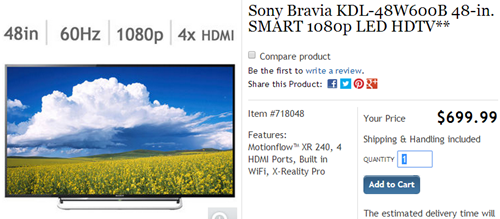
Sony Bravia KDL-48W600B 48” Smart TV (2014)
Sony KDL-48W600B (click to Costco page)
The new Sony 48” smart TV looks like a good choice when coupled with a $60 five year warranty. We've had numerous Samsung products over the years and they tend to look cheap.

We got the Sony, which is noticeable better. Even the carton shows more thought. Taking a large item out of a box isn't much fun. We normally put the box on its side and slide the item out. Sony has a U-shaped cardboard sleeve that goes around the TV. That's perfect for lifting the TV out. There are better warnings about the dangers to children and a smoother setup. The smart TV is easier to use (perhaps because we have a 2014 design).

There are several drawbacks:
  • Sony uses an ugly brick with a too-short cord for power (Samsung only requires a cord)
  • The HDMI and USB are on the back to the left, which makes them tougher to reach with a larger screen (Samsung puts them on the right hand side)
  • Netflix programs stop, as if the WiFi signal is weak. Further testing shows the cause is likely the Netflix app, which will likely be updated soon.
  • The remote control isn’t illuminated

The are advantages too:

  • anti-glare coating reduces reflections
  • nice design (thin bezel, metal stand)
  • works well as a computer monitor (text visible from feet away)

The Next 10 Years

Having a smart TV does make a difference. There's lots of content to watch and a larger screen is wonderful for showing detail. We aren't returning to broadcast TV or pay TV. We're only paying for Netflix.

How long will the new TV last? The warranty assures us of five years. We hope to keep the TV longer but even if we can't the overall cost is reasonable since we didn't get a pricey set.

There's more you can do with a TV today, such as viewing photos on a large screen. Thanks to WiFi, we're no longer limited by the location of the cable outlets. Hurray for progress. Plus, if the TV breaks down we know we’ll manage.

Links

PS Life without the Internet would be tougher to survive.

June 28, 2014

MAKE SURE YOUR INTERNET SERVICE IS RUNNING AT THE PROMISED SPEEDS

Rogers certified Internet speeds
Internet service isn’t cheap. How do you know if you’re getting the speeds you’re promised (and paying for)? You can’t tell unless you monitor regularly. You then have a baseline for comparison.
Your Own Tests
You can run your own tests with Ookla SpeedTest from your browser or as an app on your mobile device. For better results
  • measure via a wired Internet connection (Plan B: use a wireless device close to your WiFi source)
  • disconnect all other devices accessing the Internet (Plan B: accept lower results)
Note: The speed over WiFi is lower, fluctuates and varies by room. One reason to get a faster plan is to accommodate these drops. (Related: How to get your wireless Internet working)

If the results are far from what you expect, call your provider to find out what’s wrong.
Detailed Monitoring
Rogers is the only Internet provider in Canada with certified speeds. We’re part of the independent monitoring via SamKnows. Our service is monitored 24/7 and we can see the detailed reports ourselves. That’s how we find out and verify problems.

Speed Today

Our Rogers Ultimate unlimited plan promises 150 Mbps downloads and 10 Mbps uploads. We routinely get faster downloads (about 190 Mbps) and slightly faster uploads (about 11 Mbps). Since our service is reliable and stable, we don’t routinely check the performance.

Our speed today is much lower than usual — about 100 Mbps (blue line in graph below) instead of 150 (the red line). That’s too big difference to ignore.
speed today

Speed This Month

This month, our service started deteriorating on the 10th. That’s when the blue line dropped below the red line below. We noticed but didn’t notice because our service was still fast. That’s another reason to get a faster plan.
speed this month
Anomalies happen and are usually fixed quickly. I called Rogers. They said our Internet signal strength has dropped to marginal levels. They’re sending a technician tomorrow.

Speed This Year

Overall, Rogers is excellent at delivering consistent fast speeds. This graph of speed year-to-date shows this. The last slowdown was minor, months ago and quickly fixed. At that time, there was apparently a problem affecting the neighborhood, perhaps caused by the polar vortex.speed this year

Lessons

Just because speeds are independently certified doesn’t mean you’re getting them or will keep getting them.

Without monitoring, we might not have called Rogers. It’s easy to think that slowdowns are caused by other users, including family members. If we checked the monitoring more regularly, we would have had a fix earlier.

Links

PS We upgraded our unlimited plan from 150/10 plan to 250/20. Is Hybrid Fibre better? I’ll share details once our service is fully functional.

June 8, 2014

FIVE MONEY LESSONS FROM JACK BAUER AND 24

Jack Bauer 24
We can learn valuable lessons about money from Jack Bauer (Kiefer Sutherland) and others in the Counter Terrorism Unit (CTU) . Here are five.

1. Communicate Clearly

When time is tight, every word and second matters. In 24, you know what’s said and what’s meant. Simple questions get asked if there’s a need for clarification or confirmation.

Does your advisor have a clear understanding of what you want? Your goals and priorities may have changed since your last meeting. Advisors are not mind readers and may not be proactive. Tell them.

Conversely, your advisor also has an obligation to communicate clearly with you. If you don’t understand, ask. Since you’re paying, you’re in charge. Get your money’s worth.

2. Trust With Caution

The world of 24 is filled with mistrust. You can't tell who’s telling the truth or how long the honest will stay truthful. The stakes are very high and human motivation is complicated. There are conflicting interests. The losers don't accept defeat willingly.

Defiance harms trust. When people think they're doing right, they may bend rules, violate direct orders and tell blatant lies. The bad people have an advantage because they aren't constrained by rules of law.

Building relationships is a key strategy for advisors. Relationships help retain you as a client and make you more receptive to advice. As the years pass, you can become more vulnerable. For instance, Tom Hanks got cheated by his insurance advisor but the process took years. In 24, the process is much faster.

3. Each Moment Is Unpredictable

The world of 24 is filled with twists and shocks. We don't know what’ll happen in the next moment or next hour. That’s true in real life too.

On 24, we know Jack will overcome setbacks and achieve the key goal. Our lives have drama but don't come with the same assurances. Unpredictable events like injury, sickness or death are rare in our working lives (low probability) but can cause serious financial hardship (high severity). Insurance is a cost-effective way to transfer the risks.

4. We All Need Help

Jack is the main character but he relies on help from many others. Sometimes he asks the wrong person but things eventually work out. Diligence is important. Keep inspecting what you're expecting.

Since each organization has different strengths and limitations, Jack gets help from different places (CTU, FBI, the NSA, the President). If you rely on advisors from the same firm, you get convenience but risk unknown compromises. You get more options with independent outside advisors.

Sometimes Jack can’t get the help he needs because the providers havce conflicting interests. The good of the many can take precedence over one life. That makes sense unless you’re the one. That’s when you need to look out for yourself.

5. Be Flexible

Events don’t happen as expected. When a plan fails in 24, Jack and team make instant changes with minimal discussions based on the little information they have.

Our own lives often lack the excitement a viewing audience demands. That's good. Precautions like insurance reduce the drama further.

After all, Jack Bauer and CTU are forms of insurance — well worth the premiums.

Links

PS We never watch 24 before. Thanks to Netflix, we’re well into the third season.

May 10, 2014

THE DIRT ON PETRO-CANADA’S CAR WASH SEASON PASS INSURANCE

Need a car wash
A clean vehicle is important because I meet lots of clients. Since handwashing is inconvenient, we have a SuperWorks Car Wash Season Pass from Petro-Canada. This card gives you a SuperWash once a day for 90 days. You choose the vehicle and could even lend your card to a friend. The pass launched in 2008 for $149+tax and has crept up to  $179+tax. You save $10 by reloading online.

If you register your card with Petro-Canada, you get free insurance: they’ll replace a lost or stolen card without charge.

Great Need

SuperWorks Car Wash Season Pass
I’ve been doing highway driving and have bugs splattered on the windshield. That’s where a squeegee and car wash help. Besides, tomorrow is Mothers Day. Getting a car wash is easier than vacuuming the house.

I was about to get a SuperWash but couldn’t find my Season Pass. I looked and looked. Now’s the time to see how they handle claims.

The Expected Process

I figured that I’d
  1. Go online to report the card was missing
  2. Print out a form authorizing a free replacement
  3. Get a new card at a Petro-Canada location
In the background, they’d cancel the old card. Quick. Simple. Wrong.

The Real Process

The actual process is much more cumbersome.
Instructions from Petro-Canada
A whole network for customer service? That looks impressive. I phoned and listened to their menu options (which have changed to serve us better). Once I got to the right spot, the recording says:
“Our office is currently closed. Please contact us Monday through Friday from 8 AM to 8 PM Eastern Standard Time. Thank you for calling Petro-Canada.”
Why doesn’t their website say they have limited operating hours? It’s a warm, sunny Saturday. I’ve got an unwashed car for the weekend, including Mothers Day. I don’t want to vacuum the house.

Another Path

Twitter allows companies to provide excellent customer service (four examples).
image
Petro-Canada started @petrocanada in January 2009 but has only has 669 tweets. The latest is more than two months old. I didn’t get a timely response.

Too Demanding?

If I can’t find my car wash card, is that Petro-Canada’s fault? Not really but they offer replacement insurance. We live in a world of 7 days-a-week shopping. Why is their Customer Service Network closed when their car washes are open?

Besides, I’m paying a premium because they keep sending me emails to read. I’m also spending extra time filing a claim.

Links

PS Now to find the vacuum cleaner …

April 13, 2014

LIFE-CHANGING: THE FREE SHRI AMBIKA YOGA KUTIR COURSE IN TORONTO

image
Related: Find out about the next course

This year, I’ve been focusing on my health by
  • eating better
  • sleeping earlier
  • exercising more
The big challenge is exercise. Good intentions haven’t translated into ongoing habits,

Intentions vs Actions

Visiting a fitness club takes time, planning and waiting for equipment. Yoga looked like a good way to exercise at home before breakfast. Since pure yoga melds body, mind and soul, I wanted
  • sevaks (teachers) who knew the ancient ways from India but taught in English
  • an extended, structured course (rather than a workshop)
  • personalized attention (rather than a student in a large class)
Is that asking too much?

The Solution

A fellow Toastmaster told us of a free 16 week course in West Toronto (Etobicoke near Kipling/Rexdale). My wife attended Shri Ambika Yoga Kutir and recommended I join. That’s a big commitment. The classes take place at 7:00:00 AM on Saturdays. I’m not a morning person and don’t like sleeping early on Friday nights. Would I have energy to travel and take a two hour class before breakfast?

I made a commitment and haven’t missed a single class despite the extreme winter. Since lessons build on each others, that’s important.

Benefits

Here the main benefits I’ve already achieved
  • more energy all day: the breathing exercises help you get more oxygen into your blood  — especially via Kapal Bhati (shallow bellows breathing)
  • better posture: you tone muscles which often get ignored (e.g. in your spine and neck)
  • more flexibility: we don’t use positions like padmasana (lotus posture) in our daily lives
Perhaps the greatest benefit is the confidence that comes from persisting and not quitting. My life has changed and will continue to improve as I continue the yoga.

The Catch?

The course is free and that’s not a trick. You’re not put on a commercial mailing list. There are no attempts to upsell you (because there’s nothing to sell). The only way you can spend money is on the optional course materials. The best ways to repay the generosity of the volunteer sevaks is by
  • continuing to practice yoga
  • encouraging others to join (a goal of this post)
You attend to learn. Students (sadhaks) are discouraged from the usual networking and exchange of business cards.

The Format

handwritten notes for yoga class 10Each class starts with all students on yoga mats facing a row of teachers at the front of the large room.

The week’s agenda is shown on a whiteboard. Different teachers explain the theory behind the new postures, the benefits and the precautions. There are demonstrations of the new postures.
Practice
We then go to one of four groups based on our age and gender. My group (males 45+) had about a dozen students and two teachers. That’s an excellent student-to-teacher ratio. As we practiced, we got personalized attention. That’s what I really appreciated since I wanted to do the exercises properly. You can’t get that from YouTube or a conventional show-up-if-you-want class.

Each student in my group had his own strengths and challenges. We weren’t competing, though. We were encouraged to do what we could. We weren’t pressured to do exercises for which we made us uncomfortable. Some exercises had variations for different needs.

Tips

For the best results in the Shri Ambika Yoga Kutir class
  • take notes (photography and videography is discouraged; manuals aren’t available until near the end)
  • practice daily (I averaged 5-6 days a week … only skipping mornings when travelling or having unusually early meetings)
  • invest in a proper yoga mat (e.g., the well-cushioned, nonslip Manduka BM71 with a lifetime warranty)
After you graduate, you can return anytime you want to repeat the basics or take advanced classes. If you’re interested, get details about the next course.

It’s funny how our bodies respond when we take care of them. What better investment can you make?

Links

PS I’m thinking of redoing the beginner’s class to learn the basics better and stay on track.

April 6, 2014

MAILBAG: A DAY IN THE LIFE OF AN ACTUARY — MORE CAREER ADVICE

in the right field?
Here’s another request for career advice.
Hello Promod! I’m a first year student currently enrolled in the Mathematics and Statistics Co-op program at the University of Toronto. I am willing to become an actuary in the future and have no personal connection with anyone as of yet. I have a few questions regarding the career itself, and possible paths one would need to take in order to attain this career. I would appreciate if you could answer them as it would help me make my life’s first important decision.

Firstly, I would like to know how you go about handling your duties on a daily basis, in other words, if I were to be an actuary for a day, what I am going to be facing that day as a guarantee. I am also willing to know if the daily activities of an actuary are repetitive, or will my work differ from day to day? Another thing I’m willing to find out is the challenges actuaries face as a result of their career, internally and externally, whether it be the actual tasks that they complete, or whether it be the people that they face, or even potential consequences they may have. I am hoping to find what the future holds for these careers. Here, not only am I looking for whether or not the job opportunities will increase or decrease, but I am also looking for other careers that may use the skills that I have attained in these career areas.

By analyzing your responses to these questions, I would be able to figure out whether or not I see myself as an actuary in the foreseeable future. Your response to these questions would be greatly appreciated. Thank you for your time!
When I was still in the corporate world, a student asked seven questions. Another asked to job shadow me to “witness the daily activities that an actuary performs and see if I can picture myself doing the same 20, 30 or 40 years from now.”

The requests are thoughtful but life is unpredictable. Here’s another attempt at answering the underlying questions.

Starting Out After Graduation

In each of 1983 and 1985, Metropolitan Life hired six actuarial grads for the Canadian Head Office (CHO) in Ottawa. In 1984, the economy was bad and they only hired me. The unemployment rate among my classmates was 77% (only 4 of 17 got jobs). Is the economy any more predictable today?

I got the usual actuarial equipment: a big electric printing calculator and a monochrome terminal connected to an unseen mainframe computer. No Internet. No smartphones. No answering machines.

On the plus side, you couldn’t take work home.

I shared a telephone with a coworker who smoked at her desk. Another colleague got sent home for forgetting to wear a tie. At the time, Metropolitan Life was the second largest life insurance company in North America. Within years, they left Canada. I had already moved on.
My Evolution
You gravitate toward the type of work you like and are good at doing.

I’ve been good at learning, experimenting and communicating. Much of my work was project-based. For instance, launching a new product. I liked variety, uncertainty and making decisions. You might prefer work which is more predictable and guided.

Shortly after I started working at Met Life, the Chief Actuary (my boss’s boss’s boss) wanted basic color graphs for an important presentation. I didn’t know how to create them but no one available did either. We were in the early days of computers and graphing printers used expensive felt pens. I learned how to graph and found ways to communicate results better than expected. I made my boss, boss’s boss and boss’s boss’s boss look good. Do that and you look good too.

In those days, actuaries did coding (then called “programming”) in APL — powerful but tough to use well. I became good through self-study, which opened up more opportunities. Even today, coding is considered a must-have job skill. You can learn for free on your own time, how many bother?

You gain a valuable edge when you do what others can’t or won’t do.

A Typical Day

There’s no typical job, which means there’s no typical day. Roles change with circumstances, your abilities and your level.

An actuary is trained to measure and manage risk. That seems technical but computers simplify the work. Success requires many soft skills such as getting along with others, communicating clearly, thinking independently, innovating and meeting deadlines.

There are many different kinds of actuaries. I’ve worked primarily in the world of personal insurance (life, critical illness, disability). While the product actuary at National Life, I had three actuaries reporting to me. We focused on universal life insurance optimized for wealthy clients. Success required creativity, a deep understanding of the tax laws and the creation of effective point-of-sale computer-based tools.
The Team
I had an actuary for each of these core responsibilities:
  1. New product development:  analyzing competitiveness, calculating profitability including “what if” scenarios, writing product descriptions (for the launch process)
  2. Advisor support: answering questions, developing/testing point-of-sale computer-based marketing tools, gathering market intelligence
  3. Administrative support: getting the customer service systems updated to accommodate the product features, drafting policy contract wording, projecting performance of inforce policies
Each role was important but required different skills and personalities. My other seven staff were also involved, primarily with advisor support. Managing people was necessary but not as easy or enjoyable as I first thought. I invested time in learning how to get better.

Career Stages

When you get your first job, you'll be doing work related to your skills. Since your skills are limited, don't count on doing work which is especially interesting. You're learning how to meld into the working world — skills you only master by doing. Demonstrate your growing skills and and you’ll get new opportunities.
Changing Roles
Big insurers like Met Life had a rotation program for students writing the actuarial exams (10 at the time). You work in a department for two years. The first year, you learn from the actuarial student who's about to leave. The second year you train your replacement. This process helps you decide which department suits you. I worked in Corporate Finance, Personal Insurance and Group Insurance. That left Investments and Pensions but I left the company by then.

You also got paid study time (3 workdays per hour of exam). For a five hour exam, that's 15 days (three workweeks). Write twice a year and that's 30 work days (six workweeks). Add three weeks of vacation and you’re away nine weeks a year. Plus you get juicy salary increases for passing.

I don’t know what the practices are in today’s leaner world since I’m in the nontraditional role of helping the public review, repair and renovate their insurance at Taxevity.

Your Brand

There's tremendous value in building a personal brand. That was very difficult in the past, even if you wanted to stand out. How could anyone find you? Now we have Google. How could they gauge your experience? Now we have LinkedIn. How could you show your thought leadership? Now we have blogs. How could anyone  hear or see you? Now we have podcasts and YouTube, respectively.

What’s your strategy? When will you start? When you’re looking for work, your classmates are your competitors …

The Opportunities

As a student, you’re usually too young to make the right decisions for a 30-50 year career. It’s easy to get fooled by common career myths. Look around. Despite best efforts at planning, many people hate their jobs and even change careers (though the oft-repeated estimate of  seven career switches seems unlikely).

The good news is that you don’t have to make the right decision today. You just need to make a good decision and then adapt. Keep developing portable skills to keep fresh and maintain your edge as new opportunities arise.

Links

PS Even if you’d rather not, keep building trust with networking.